In 2025 the Swiss watch industry has contended with a markedly more complex environment, as shown by the two key industry reports. They are the Morgan Stanley-LuxeConsult watch report and the eleventh edition of the Deloitte study, which is based on a survey of senior executives and 6,500 consumers. Post-Covid fever, which peaked in 2023, has subsided and Switzerland’s watch industry has entered a period of turbulence, prompting brands to respond with caution and lucidity.
Swiss watch industry fights back. Swiss watch industry fights back. Swiss watch industry fights back. Swiss watch industry fights back. Swiss watch industry fights back
Swiss watch industry fights back. Swiss watch industry fights back. Swiss watch industry fights back. Swiss watch industry fights back
15 December 2025
Swiss watch industry fights back
The 2025 Deloitte and Morgan Stanley-LuxeConsult reports describe an industry facing one of its most complex periods in recent history, characterised by increased polarisation, a shifting export landscape and hawklike attention to consumer behaviour.
Almost highs and lows
Data released by the Federation of the Swiss Watch Industry (FH) shows that 2024 watch exports recorded a year-on-year decline of 2.8% in value terms, achieving a total CHF 26 billion, while volume sales contracted by 9.4% to 15.3 million units. This tendency has continued into 2025, with a 1.6% fall in value to CHF 21.2 billion and a 5.5% drop in volume to 11.9 million units over the first ten months of the year. In spite of current headwinds, Swiss watch exports have therefore held more or less steady in value terms (as inventory grows in certain markets), whereas the number of exported units has recorded a significant decline. No doubt this constitutes one of the major challenges facing an industry that needs to maintain a solid industrial base if it is to continue with innovation. This differential between volume and value is also indicative of the sector’s gradual shift towards higher price points.
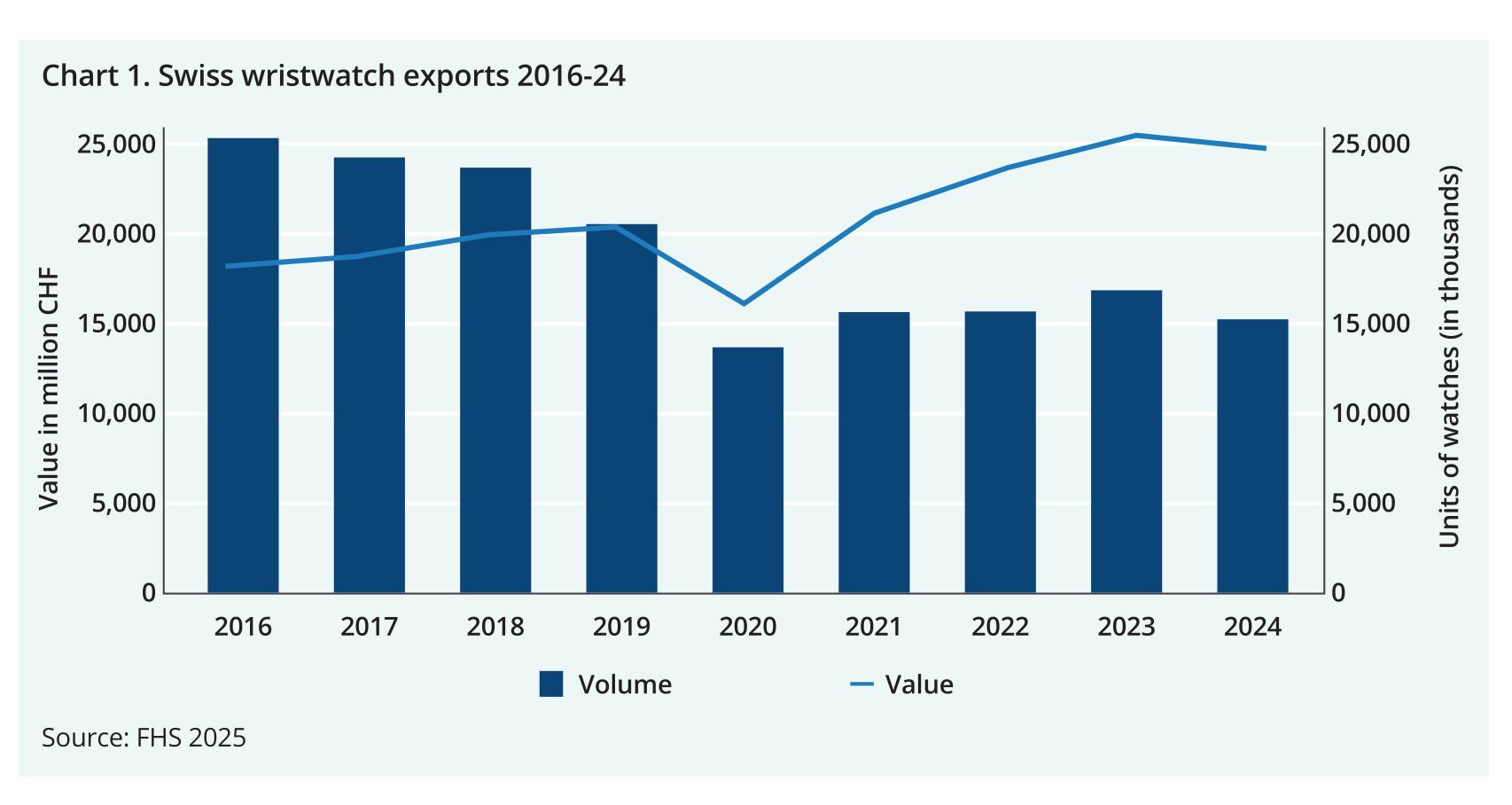
Both Morgan Stanley-LuxeConsult and Deloitte describe a polarised market. While high-end (and in some cases ultra-luxury) segments remain remarkably resilient, more affordable watches are performing less well, particularly as a result of stronger competition from smartwatches, and volume sales, which have historically driven exports, have contracted. Momentum is now in the hands of a small number of brands whose products are deemed rare and desirable. Among them, alongside the group-owned famous names, independent makers are capturing attention.
Under control
The industry faces what Deloitte describes as “one of its most complex periods in recent memory.” A strong Swiss franc, more cautious consumer spending and instability in certain key markets are three negative factors that Deloitte highlights in its report. Additionally, the introduction of US tariffs in early 2025 has injected greater uncertainty. “The watch industry has been going through numerous cycles of disruption,” notes Cyrille Vigneron, Chairman of Cartier Culture and Philanthropy who served as CEO of Cartier between 2016 and 2024. “Now these are more frequent with shorter horizons, requiring enhanced agility.”
In these uncertain times, distribution takes on a key role. As Deloitte notes, regardless of the rising tide of online channels, consumers are returning to physical stores. Sixty per cent of respondents said they were more likely to buy from a brick-and-mortar store, citing the importance of being able to feel and try on the watch, as well as the personal relationships and advice offered in stores. Despite the greater popularity among consumers of multi-brand stores, new brick-and-mortar mono-brand openings are a sign that, beyond the question of margins, brands wish to have control over their narrative, the product environment and the overall customer experience.
More than one careful owner
This wish to control the entire value chain extends to another now strategic area: the pre-owned market. As the Deloitte study observes, buying a pre-owned watch has become ingrained in consumer behaviour, particularly among younger buyers. Forty per cent of Gen Z respondents declared themselves likely to purchase a pre-owned watch within the next twelve months. Reasons range from access to discontinued models to lower cost, against a backdrop of premiumisation and rising prices for new watches. This evolution, according to Morgan Stanley-LuxeConsult, is clearly driven by polarisation in the primary market which fuels demand for brands’ emblematic timepieces and, consequently, their presence on the pre-owned market — to the point that some brands now consider their second-hand models to form a natural extension of their initial offering.
Economic turbulence is redrawing the borders of global watch sales. No longer the force it once was, China has been losing ground for two years. Figures published by the FH reveal a cumulative decrease in Swiss watch exports to China of almost 40%. Shipments to Hong Kong lost almost a third over the same period. Both these markets have fallen behind Japan and are only just ahead of the United Kingdom and Singapore. After several years of phenomenal growth, the situation in the United States, which is by far the most important destination for Swiss watches, will depend on the impact of tariffs, once inventory has run out. Meanwhile, new frontiers are emerging. Exports to India grew 35% over two years, driven by a fast-growing middle class; Mexico accounted for almost half of Swiss watch exports to Central and South America in 2024. This shifting landscape is not without consequences for the industry, which will have to adapt its sales structures, discourse and production — knowing that “easy growth” is a thing of the past.
Going forward, value creation will require a strong identity, control over volumes and distribution, and an imaginative, honest and respectful relationship with consumers.