FHH | Women in the watch industry

Women in the watch industry . Women in the watch industry . Women in the watch industry . Women in the watch industry . Women in the watch industry

Women in the watch industry . Women in the watch industry . Women in the watch industry . Women in the watch industry

02 June 2025

Women in the watch industry

Women are essential to the Swiss watch industry, making up almost half its workforce but only 20% of management positions. 

Without women, the Swiss watch industry would probably never have soared to its current heights, yet for centuries the watch world remained a male-only territory. Timepieces, so it was believed, were a man’s business, crafted by masculine hands for a masculine wrist. In a world that showed little consideration for the women at its workbenches, a woman’s watch was deemed little more than a decorative item that gave the time. While historical fact and industry statistics doubtless demonstrate a different reality, there is an element of truth in the suggestion that for a long time (too long), women have been the watch world’s second-class citizens. It took time, tenacity, temerity even, for women to leave the factories where brands employed them for repetitive, even dangerous tasks. But where does that leave us today?

The census conducted by the Convention Patronale de l’Industrie Horlogère Suisse (CPI), the umbrella organisation for employers in the Swiss watch industry, shows that the country’s third largest export industry is also one of its major employers. Over the six years to end 2023, its workforce grew by 19% to 65,200 people and this figure remained stable (+0.6%) in 2024, despite a depressed economic climate. Women occupy 42.7% of Swiss watch industry jobs overall, 42.9% when considering production alone and 44.3% of administrative positions. This almost equal split between men and women should be enough to silence criticism… or not, given the under-representation of women (19.5%) at executive level. When it comes to corporate governance, women are outnumbered 4 to 1. 
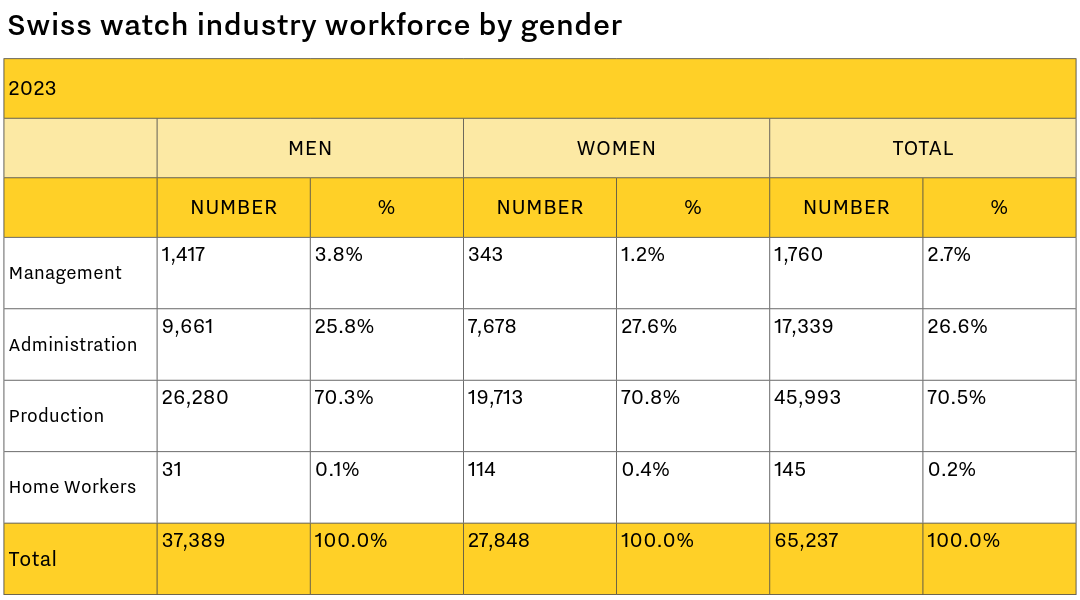
Swiss watch industry workforce by gender

Source: Convention Patronale de l’Industrie Horlogère Suisse – 2023 Census

Conspicuous by their absence

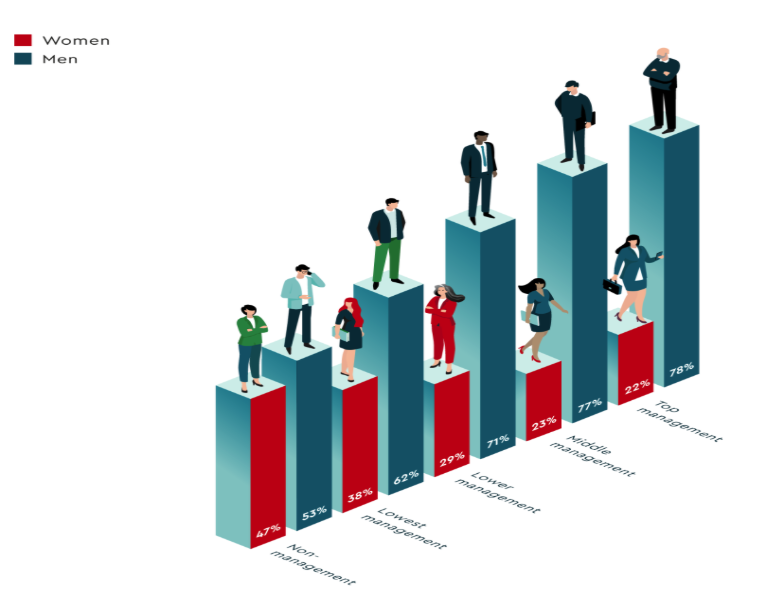
Not that this gender gap is limited to watchmaking. The research institute for international management at University of St. Gallen analysed anonymised data for 370,000 employees at almost one hundred Swiss companies across all economic sectors. Its findings, published in the Gender Intelligence Report 2024, show that while women and men are (almost) equally represented at non-management level, women are significantly absent from managerial roles: a fact carried over from previous years, note the authors, for whom 2024 is in the same vein: “While women occupy 47% of non-management positions, they account for only 22% of top management.” A word, too, on the gender pay gap, which ranges from a 7% difference in gross salary at the bottom rungs of the ladder to 18% in middle and top management. Even worse: if we consider annual bonuses as a reflection of an employee’s perceived value, what should we make of the stupefying 54% average bonus gap between women and men? 

Gender Intelligence Report 2024

Source: Gender Intelligence Report 2024

Writing on the Vaucher Manufacture Fleurier blog, watchmaker Benoît Conrath notes that, “jobs are no longer gendered. Women are everywhere, in every profession and in management. Pay equity has, in some cases, been achieved, though not always for qualified jobs or at executive level. Although progress is being made at companies such as ours there is still some way to go for women to be acknowledged in the watch industry.” Yet some are happy to see the bottle one-fifth full rather than empty, inversely proportional to the hope, not to say firm conviction, that women are closer to achieving parity. 

Girl power

The upsurge of interest in mechanical watchmaking in the early 2000s together with the watch’s newfound status as a luxury product largely contributed to a “feminisation” of the industry. Brands not only realised that half their target audience was — potentially — composed of women; they began to (timidly) open boardroom doors to women. Others grew tired of waiting and set up their own company.

At Swatch Group, Nayla Hayek chairs the board of directors; a position Jasmine Audemars long held at Audemars Piguet, which recently appointed Ilaria Resta as its CEO. Within the Richemont group, after six years leading Jaeger-LeCoultre, Catherine Rénier heads Van Cleef & Arpels, a role Chabi Nouri held at Piaget. Chopard is co-presided by Caroline Scheufele; Christine Rosnoblet steers the fortunes of Speake-Marin; Fiona Kruger and Alcée Montfort are at the helm of their own brands, as is Christine Hutter at Moritz Grossmann in Glashütte. Amanda Mille and Cécile Guénat have executive positions with Richard Mille while watchmaker Carole Forestier-Kasapi is movements director at TAG Heuer. Away from the boardroom, craftswomen such as enamellist Anita Porchet and engraver Michèle Rothen are outstanding in their field. Certain of the contractors supplying the industry are also female-helmed, such as watch hand manufacturer Fiedler, led by Isabelle Chillier. 

Women in the watch industry

Women in the watch industry

Granted, the list doesn’t run to dozens of pages but it does have a substance that would have been unthinkable some twenty years ago, when you could count the number of female executives on the fingers of one hand. The likes of Aletta Stas, co-founder of Frederique Constant, or Nathalie Veysset at the head of De Witt. But as Aurélie Picaud, director of timepieces at Fabergé, recently commented with respect to women’s rights and experience: “Regrettably, not all workplaces respect the most basic principles such as equal pay, opportunities and recognition.” Can the watch industry set the record straight? 

A political response

Women’s presence, or absence, from leadership positions at Swiss companies has prompted a political response. In accordance with an ordinance issued by the Swiss Federal Council, since 2021 listed companies have an obligation to appoint more women to executive roles. The Council has set a threshold of 30% for boards of directors and 20% for executive committees. From 2026 (for boards of directors) and 2031 (for executive committees), companies that fall short must explain, in their compensation report, why these quotas have not been reached and indicate which remedial measures they will take.